People often assume fabrication is mostly welding. In practice welding is one step near the end, and the work that decides whether a job comes out right happens well before an arc is struck.
Here is what actually goes on between “I need a gate that fits this opening” and a finished item bolted into place.
It Starts With Measuring, Not Cutting
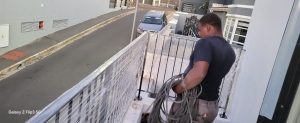
Every custom job begins with real dimensions taken from the actual opening or mounting point. This sounds obvious, but it is where most problems originate. Openings in older Cape Town properties are rarely square. A gap that measures 900mm at the top can be 913mm at the bottom, and a gate built to a single number will bind or leave a gap.
Good fabrication measures in several places and builds to the reality of the opening rather than to a round figure.
Cutting and Preparation
Material is cut to length from stock section – square tube, angle, flat bar, sheet. Clean, square cuts matter because every inaccuracy compounds once parts are assembled. A cut that is two degrees off will show as a visible gap at the far end of a long piece.
Edges are then cleaned and, where the joint requires it, prepared. Thicker material often needs a bevel so the weld can penetrate the full thickness rather than sitting on the surface.
Forming and Shaping
Not everything is straight. Bending, rolling and shaping turn flat stock into brackets, curves, frames and panels. Working out the bend allowance – how much material a bend consumes – is what stops a formed part from ending up short. Our guide to sheet metal bending and shaping covers what is possible here.
Assembly, Tacking and Welding
Parts are held in position, usually in a jig or clamped to a bench, and tacked with small welds. Everything is checked square at this point, because a tacked assembly can still be corrected. Once fully welded, it cannot.
Only then is the item welded out properly. Welding sequence matters more than people expect – heat pulls metal towards the weld, so running every joint in one direction will visibly distort a frame. Alternating around the piece keeps it true.
Finishing and Coating
Welds are dressed back, sharp edges removed, and the item prepared for its coating. What happens here decides how long mild steel lasts outdoors, which is a bigger deal near the coast than most people realise. See galvanising, powder coating or paint for how the options compare.
Why Lead Times Vary So Much
Two jobs of similar size can take very different amounts of time. Material availability, how much forming is involved, the coating process, and whether installation needs site access all move the date. A simple mild steel bracket is quick. A stainless balustrade with a brushed finish and site fitting is not.
See mild steel fabrication and custom steel fabrication for the kind of work this covers.
Frequently Asked Questions
Can you fabricate from a drawing or sketch?
Yes. A dimensioned drawing is ideal, but a clear sketch with accurate measurements is usually enough to start. For anything fitting into an existing opening we prefer to measure on site, because drawings rarely capture how far out of square an old opening actually is.
How accurate does my measurement need to be?
For a quote, within a centimetre is fine. For manufacture, the opening should be measured properly at several points – width at top, middle and bottom, and the same for height – because openings are seldom perfectly square.
Why does welding distort metal?
Heat makes metal expand, and as the weld cools it contracts and pulls the surrounding material with it. This is why welding sequence matters: alternating joints around a piece balances the pull, while welding one side straight through will bow the frame.
Related Welding & Fabrication Services in Cape Town
Supar Steel offers a full range of welding, steel and aluminium fabrication services across Cape Town. Explore related guides and services: